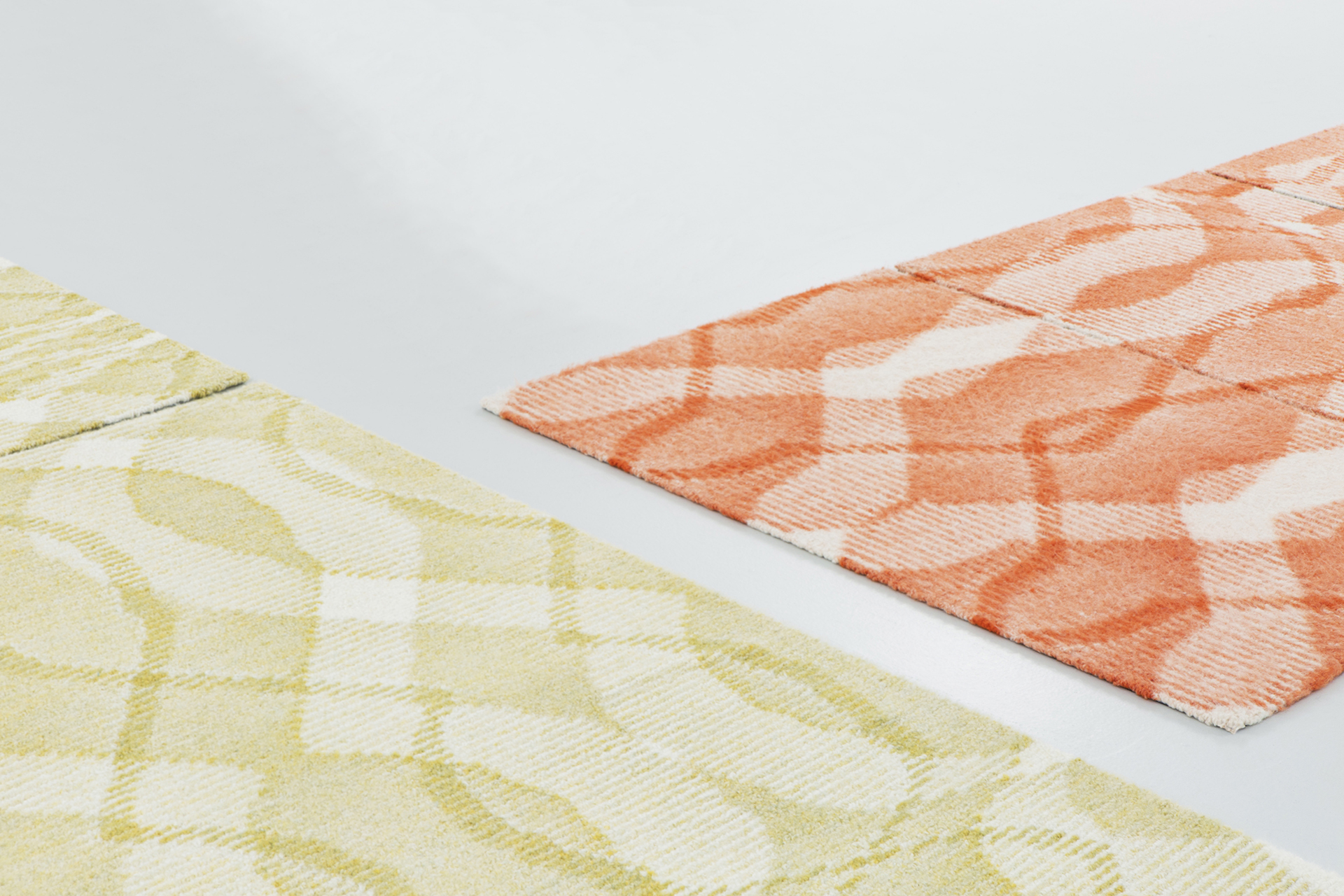


Between 2011 and 2014, Diane Steverlynck worked on the industrial development of yarns with great bi-coloured rhythms for use in creating rugs with fluctuating patterns. In the course of this project, she collaborated with Pierre Marchand to create an open-source computer program to preview the graphical phenomenon of a yarn composed of given color sequences and their use in different textile techniques, particularly large tufted formats. This research led to the production of several yarns in collaboration with textile engineer Armand Steinbach (Diese Wolle). We found out how to “disrupt” the spinning machine’s existing settings in order to obtain new graphic possibilities. The yarn with its repetitive motif was then, in turn, “disrupted” during the making of the carpets, thus creating infinite variations from the preview designs we had generated with the computer program.
This process of encoding into a yarn at the spinning stage echoes the traditional Ikat technique. Traditionally obtained thanks to reserve dyeing techniques, the pattern is created on the yarn in anticipation and is revealed only at the moment of the “construction” of the fabric.
The developed production process creates graphic fluctuations from one piece to another. The slightly different thread consumption of each tufted line allows for variation in the pattern, making each piece unique and revealing how the surface is literally drawn by the yarn itself.
Open source program ‘Fuzzy Rug’ constructed with Pierre Marchand (2011)
https://github.com/pierremarc/FuzzyRug
Related exhibitions:
Des Choses à Faire, CID, Grand Hornu (2017)
Trans-Formations, Mad Brussels (2025)